
Prosthodontic treatments covered by most insurance plans
Se Habla Español | Falamos Português
Dental implant placement is only as predictable as the planning behind it. At Ocean Breeze Implant Aesthetic Dentistry, Dr. Nicholas Goetz uses custom 3D-printed surgical guides for implant cases in Boynton Beach, templates fabricated from your CBCT scan and intraoral data that direct the exact angle, depth, and position of every implant during surgery. The result is guided placement accurate to within approximately 1 millimeter of the planned position, with less trauma and faster recovery than freehand techniques.

Most dental practices that place implants do so freehand, relying on clinical judgment to estimate angle and depth in real time. At Ocean Breeze, every implant case begins with a digital treatment plan built from your CBCT scan and intraoral data. Dr. Goetz designs your final restoration first, then positions the implant to support that outcome, not the other way around. The surgical guide is the physical tool that carries that plan into the procedure with mechanical precision.
This approach, prosthetically-driven planning, is the standard of care for complex implant cases and is what separates specialist-level implant treatment from general dentistry. Explore our full range of dental services available to Boynton Beach patients.
A dental implant surgical guide is a custom 3D-printed template, fabricated from biocompatible resin, that fits over your teeth or gum tissue and directs the surgical drill to the exact position mapped in your digital treatment plan. Every sleeve in the guide corresponds to a specific implant site, controlling the angle, depth, and trajectory with mechanical precision that cannot be replicated by freehand technique.
The guide is designed by merging two data sets: a Cone Beam CT (CBCT) scan that captures your full jaw anatomy in 3D, and an intraoral scan of your tooth and gum surfaces. According to the American Dental Association, research shows guided placement achieves accuracy within approximately 1 millimeter of the planned position, making it the standard of care for complex implant cases.
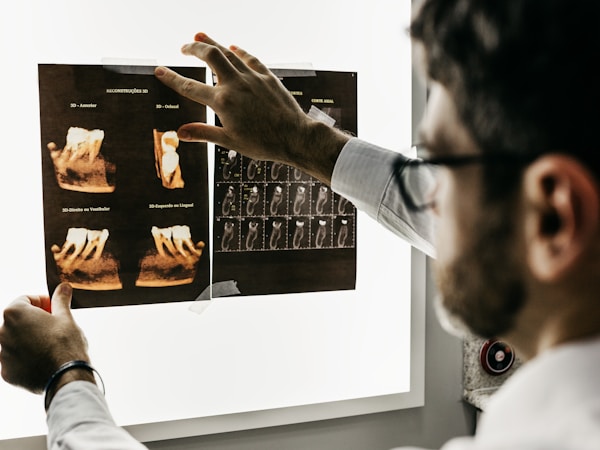
While Dr. Goetz uses surgical guides for the majority of implant cases, they are especially important when the anatomy or case complexity leaves little margin for error. The four situations below represent the highest-stakes scenarios where guided placement is not just preferred, it is essential.
All-on-4, All-on-X, and implant-supported denture cases require multiple implants to be placed in precise parallel alignment so the final prosthetic seats correctly and distributes bite load evenly. A surgical guide ensures that each implant lands exactly where the prosthetic design requires, angulation errors in full arch cases can make the restoration impossible to fit or cause premature failure.

Surgical guide planning demands a clinician who understands both the surgical and restorative sides of the implant equation. Dr. Nicholas Goetz is trained as a maxillofacial prosthodontist, a specialty focused on restoring teeth, bite, and facial structure, which means he designs the final restoration before planning the implant position, not after.
Dr. Goetz holds a DMD and MS from the University of Florida, where he completed his Prosthodontic Residency, and went on to complete a Maxillofacial Prosthodontics Fellowship at UCLA. He is one of approximately 150 maxillofacial prosthodontists in the United States, with clinical experience from U.S. Army and VA Medical Center settings.
For implant patients in Boynton Beach, that background means the surgical guide is built to support the final restoration, not the other way around. Every case is planned end-to-end by the same specialist who will place the implant and deliver the crown.
The implant is placed through the guide’s precision sleeves following the exact drill sequence, depth stops, and angulation mapped in your plan. Because flapless surgery is often possible with guided placement, many patients experience less swelling and a shorter recovery than traditional open-flap procedures. After osseointegration, typically 3 to 6 months, Dr. Goetz delivers the final crown, bridge, or full arch prosthetic that was designed before the implant was ever placed. Because the implant was positioned to serve that restoration from the start, the final fit is predictable and the functional outcome is correct.
Not all surgical guides are the same. There are stock or semi-custom guides used in some practices, and there are fully patient-specific guides fabricated from an individual’s CBCT scan and intraoral scan data. At Ocean Breeze Implant Aesthetic Dentistry, every surgical guide is custom, designed from your anatomy, your bone density map, and the planned prosthetic outcome, not from a generic template.
The distinction matters because implant placement tolerances are measured in fractions of a millimeter. A guide fabricated from your specific scan data can position drill sleeves to within sub-millimeter accuracy, replicating the planned position, angle, and depth at surgery with a level of consistency that no freehand technique can match. A semi-custom or reused template approximates these parameters rather than specifying them, which introduces variability precisely where variability has the most consequence.
Dr. Goetz’s surgical guides are fabricated through a fully digital workflow: CBCT scan data is merged with an intraoral optical scan of your teeth and soft tissue, and the merged dataset is imported into implant planning software. Dr. Goetz designs the prosthetic crown or bridge first, then identifies the implant position that supports that outcome within the available bone. The guide is then generated from that plan, with drill sleeves positioned to the exact coordinates determined in the software, and 3D-printed in biocompatible, medical-grade resin.
Each guide is patient-specific and case-specific. A guide designed for a single posterior implant is different from one designed for a four-implant full arch case, where the parallel alignment of all four fixtures is critical to the final prosthetic seating. For complex cases, the guide may be designed for staged surgery in phases, with different guide configurations for different surgical appointments.
Before any incision is made, Dr. Goetz verifies the guide’s fit against your actual dentition and soft tissue at the surgical appointment. The guide must seat fully and stably before drilling begins. Any discrepancy between the guide’s fit and the planned position is identified and resolved before the first drill pass, not discovered afterward. This verification step is a routine part of the guided surgery protocol at Ocean Breeze and is not something to skip in the interest of surgical efficiency.
We believe financial concerns shouldn’t keep you from treatment that can change your daily life. Ocean Breeze Implant Aesthetic Dentistry offers flexible financing options so the path to a complete smile feels manageable from the very first visit.
While we are not in-network with insurance companies, we’ll still help you get the most out of your plan. We file claims on your behalf and assist you in securing any reimbursement your PPO plan allows.

Guided surgery means less guesswork, less trauma, and a result built around your final restoration from day one. Dr. Goetz brings specialist-level implant planning to Boynton Beach patients throughout Palm Beach County.

Dr. Goetz uses surgical guides for the majority of implant cases at our Boynton Beach office, particularly for full arch restorations, cases near the sinus or inferior alveolar nerve, esthetic zone implants, and any case involving multiple parallel implants. During your consultation, your CBCT scan findings will determine whether your anatomy and case complexity call for a guide. Most patients planning a dental implant in Boynton Beach will benefit from one.
The cost of a surgical guide varies based on the number of implants being placed and the complexity of your case. At Ocean Breeze Implant Aesthetic Dentistry, the guide cost is discussed transparently as part of your full treatment plan during your Boynton Beach consultation, no surprises. We are a fee-for-service office and work with PPO plans as an out-of-network provider, filing claims on your behalf to help you recover applicable reimbursement.
The guide is fabricated through a fully digital workflow. Dr. Goetz merges your CBCT scan data with your intraoral scan in implant planning software to map each implant’s ideal position. Once the plan is finalized, the guide is designed with drill sleeves at each implant site and 3D-printed in biocompatible, medical-grade resin. The guide is seated in your mouth at the surgical appointment and used throughout the entire placement sequence.
Guided implant surgery means the position, angle, and depth of every implant is determined digitally before the procedure begins, and a physical template transfers that plan into your mouth with sub-millimeter precision. This eliminates the estimation required in freehand placement and is especially valuable for patients with complex cases involving multiple implants, reduced bone volume, or proximity to anatomical structures.
Coverage varies by plan. Ocean Breeze Implant Aesthetic Dentistry operates as a fee-for-service practice and participates as an out-of-network provider with PPO plans. Our team files claims on your behalf so you can recover any applicable reimbursement directly. Flexible financing options are also available to make guided implant treatment in Boynton Beach manageable, your full cost picture is reviewed at your consultation.
Dr. Goetz is one of approximately 150 maxillofacial prosthodontists in the United States, a specialist who plans both the implant and the restoration under one roof at our Boynton Beach office. If you are considering a dental implant, schedule a consultation to see how guided placement works for your specific case, or call us at (561) 265-1998.
Se Habla Español · Falamos Português
**Requested time is not final until you receive confirmation from our office. Please do not submit any Protected Health Information (PHI).
"*" indicates required fields