
Bone loss is one of the most consequential — and least visible — effects of tooth loss and gum disease. When a tooth is missing, the jawbone beneath it begins to resorb within weeks because the stimulation that kept it dense is gone. According to the American Academy of Implant Dentistry, bone loss of up to 25% in width can occur in the first year after tooth loss. Bone grafting in Boynton Beach at Ocean Breeze Prosthodontics rebuilds that lost volume so dental implants have the foundation they need to succeed long term.
Dr. Nicholas Goetz, a fellowship-trained maxillofacial prosthodontist and one of approximately 150 in the United States, uses CBCT imaging to assess bone volume and density in three dimensions before planning any graft. At a practice where bone grafting and implant placement are handled by the same specialist, the graft is planned as a deliberate step toward the final restoration — not a standalone procedure with separate providers making separate decisions.

Dental implants require a specific minimum amount of bone volume and density to integrate successfully. Too little bone in height, width, or density means the implant has nothing solid to anchor into — leading to failure, poor positioning, or a result that looks and functions poorly. Bone grafting corrects that deficit before the implant is placed, giving the implant the structural foundation it needs.
The graft material — whether from the patient’s own bone, a processed donor source, or a synthetic bone substitute — is placed at the deficient site and covered with a membrane that protects the graft while new bone grows into it. The integration process typically takes 3 to 6 months depending on graft size and location. Dr. Goetz uses CBCT imaging to evaluate integration progress before implant placement is scheduled — ensuring the bone is ready before the next stage begins.
The graft type and technique Dr. Goetz recommends depends on how much bone is needed, where it is needed, and how the graft site will be used after healing.
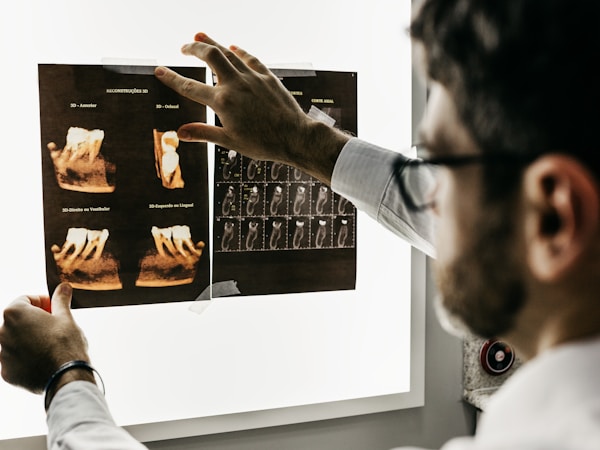
Not every implant patient needs a bone graft — but many do. CBCT imaging at your consultation reveals exactly how much bone is present and whether augmentation is necessary. The most common situations requiring a graft before implants include the following.
The longer a tooth is missing, the more bone is lost at that site. Patients who lost teeth months or years ago and are now considering implants frequently need grafting before placement is possible. The CBCT scan at your consultation will show exactly how much bone remains and what type of graft is needed to restore adequate volume.
When an implant fails and is removed, bone loss occurs at that site — often more significantly than the original tooth loss. Grafting the former implant site allows adequate bone to regenerate before a second implant attempt is made. Dr. Goetz evaluates failed implant cases thoroughly before recommending whether and when retreatment is appropriate.
Advanced periodontitis destroys the bone supporting natural teeth. In some cases, bone grafting at these sites — after gum disease has been treated and controlled — can regenerate lost support and improve the prognosis of teeth that would otherwise require extraction. These cases require coordination between periodontal treatment and grafting, which Dr. Goetz manages in the same practice.
Patients needing upper back molar implants frequently need a sinus lift because the maxillary sinuses limit available vertical bone height in that region. Losing upper molars accelerates this problem as the sinus expands into the space once occupied by tooth roots. CBCT imaging precisely maps the relationship between the sinus floor and the proposed implant site, allowing Dr. Goetz to determine the extent of augmentation needed before placement is possible.

Bone grafting at Ocean Breeze Prosthodontics is performed by Dr. Nicholas Goetz — a fellowship-trained maxillofacial prosthodontist and one of approximately 150 in the United States — who holds a DMD and MS from the University of Florida, completed his Prosthodontic Residency at UF, and earned a Maxillofacial Prosthodontics Fellowship at UCLA before serving as a civilian maxillofacial prosthodontist for the U.S. Army and the VA Medical Hospital. Complex bone reconstruction, including cases involving facial trauma, oncologic resection, and implant failure, was routine clinical work at those institutions. The standard of care he applies in Boynton Beach reflects that depth of surgical and prosthodontic training — every graft is planned with CBCT imaging and designed as a deliberate step toward the final implant-supported restoration.
A CBCT scan maps your existing bone in three dimensions — measuring height, width, and density at the proposed graft and implant sites. Dr. Goetz reviews the imaging to determine the exact type and volume of graft material needed, whether a membrane is required, and how the graft fits into the overall implant timeline. The plan accounts for both the graft and the final restoration from the start.
The graft procedure is performed under local anesthesia and, where appropriate, sedation. Graft material is placed at the deficient site and covered with a protective membrane that prevents soft tissue from growing into the graft space — allowing bone to integrate undisturbed. The site is then sutured closed. Most patients manage post-operative discomfort comfortably with prescribed medication and over-the-counter pain relief.
Bone integration takes 3 to 6 months depending on graft size and location. During this period Dr. Goetz monitors healing with periodic checkups. At the appropriate milestone, a follow-up CBCT scan confirms that integration is sufficient for implant placement. Rushing this phase risks placing an implant into bone that isn’t ready — Dr. Goetz determines the readiness timeline based on imaging, not an arbitrary calendar date.
Once CBCT imaging confirms adequate bone integration, implant placement proceeds. Because the graft and implant are both managed by Dr. Goetz at Ocean Breeze, the implant is positioned to account for the grafted bone volume and the planned final crown or restoration — not just placed at whatever angle is geometrically possible. The final crown is designed and placed in-house, giving you a complete, coordinated result from graft to crown.
Bone grafting and implant treatment represent a significant investment in long-term oral health. Ocean Breeze Prosthodontics offers flexible financing through CareCredit, Cherry, and Alpheon. While we are not in-network with insurance companies, we file claims on your behalf — some PPO plans offer partial coverage for bone grafting procedures. Our team reviews your benefits before treatment begins so costs are clear before you commit.

Browse results from implant, bone grafting, and restorative cases at Ocean Breeze Prosthodontics in Boynton Beach.

Bone grafting is performed with local anesthesia and, for more extensive procedures, sedation. The procedure itself is comfortable. Post-operative discomfort — typically mild to moderate swelling and soreness for a few days — is managed with prescribed medication and over-the-counter pain relief. Most patients are surprised at how manageable the recovery is for smaller grafts.
Bone integration typically takes 3 to 6 months. Smaller socket preservation grafts placed at extraction time heal on the faster end of that range. Larger ridge augmentation or sinus lift grafts take longer. Dr. Goetz monitors healing with periodic imaging and determines readiness for implant placement based on the CBCT — not an arbitrary date on the calendar.
Not always — but many patients do. The CBCT scan at your consultation is what determines whether sufficient bone is present for implant placement. Patients who have been missing teeth for a significant period, who have a history of gum disease, or who are receiving implants in the upper back jaw frequently need grafting before implants are possible. Some patients have adequate bone and can proceed directly to implant placement.
Several options are available and Dr. Goetz selects the appropriate material for each case. Autograft uses bone harvested from the patient’s own body — the biological gold standard, though it requires a second surgical site. Allograft is processed donor bone (from a bone bank), the most commonly used option for most socket preservation and ridge augmentation cases. Xenograft uses bovine-derived bone mineral. Alloplast is a synthetic bone substitute. Each has different integration characteristics and appropriate clinical applications — Dr. Goetz explains the recommendation and rationale at your consultation.
Coverage varies by plan. Some PPO plans cover bone grafting partially when it is clinically necessary for implant placement or tooth preservation — particularly socket preservation at the time of extraction. While we are not in-network, we file claims on your behalf and help you maximize reimbursement. Our team reviews your benefits before treatment begins so costs are transparent upfront.
If you have been told you don’t have enough bone for implants, or if you are losing a tooth and want to protect your options, a consultation with Dr. Nicholas Goetz is the right next step. As a fellowship-trained maxillofacial prosthodontist and one of approximately 150 in the United States, Dr. Goetz evaluates bone volume, implant planning, and final restoration in the same appointment — so the graft is designed from the beginning to support the outcome you want.
Schedule your bone graft consultation in Boynton Beach today by completing our contact form or calling our office at (561) 265-1998.
**Requested time is not final until you receive confirmation from our office. Please do not submit any Protected Health Information (PHI).
"*" indicates required fields